Stupid Problems
Sheep, solar, and the self-conception of systems

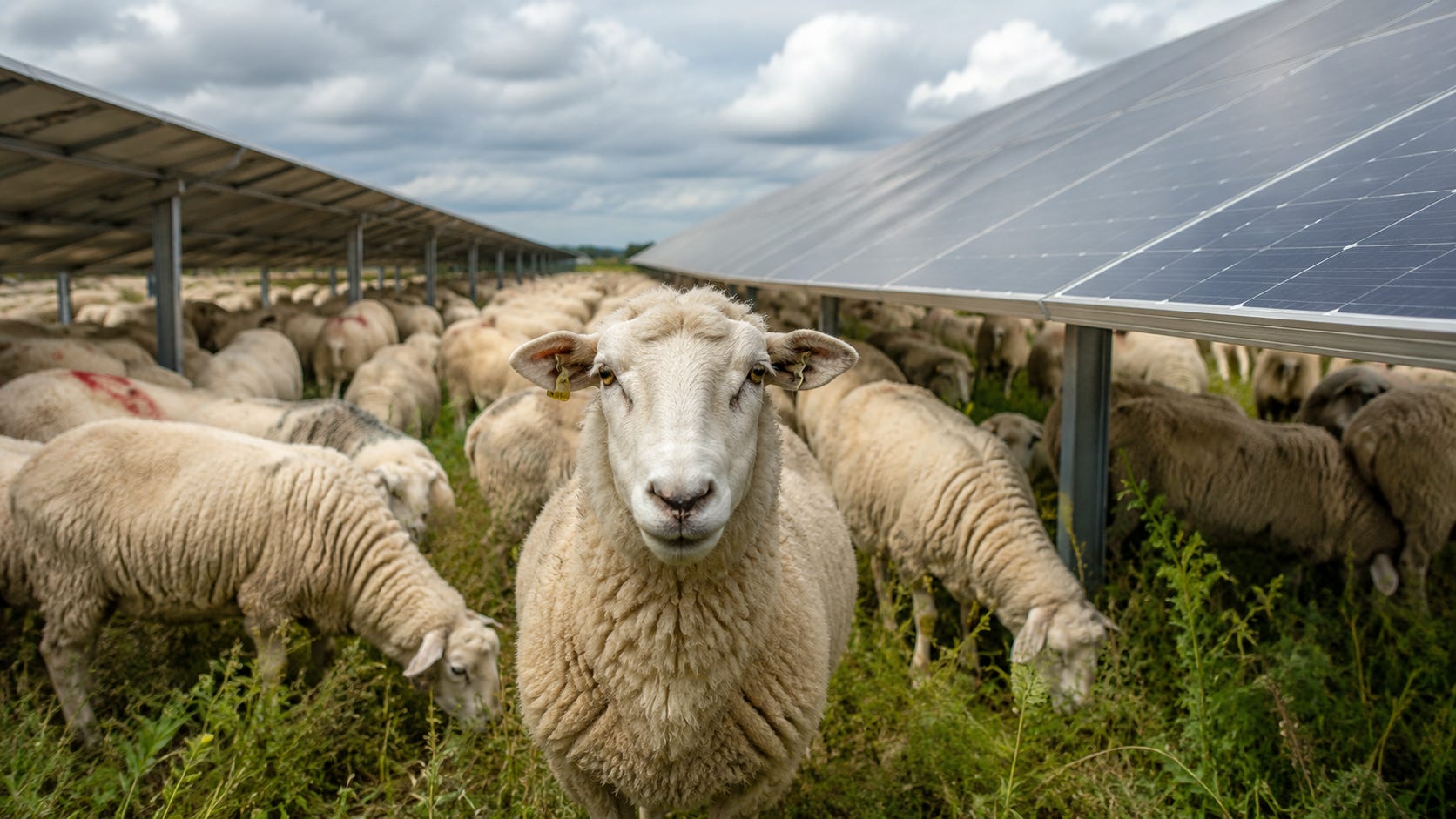
Of the secondhand insights I’ve absorbed from my husband’s work in the solar industry, this one surprised me most: the single biggest cost, for many solar farms, is cutting the grass.
This fact becomes less surprising after a few seconds of thought — they really are just big fields, aren’t they? And grass can catch fire, especially in hot, dry weather when heavy duty electrical equipment can overheat. Obviously, grass catching fire is bad for business.
Okay then, you just hire people to cut the grass, right? Often, yes. But sometimes it is actually easier, cheaper, or better to cut the grass with flocks of sheep. (Sometimes even goats! But usually not, because they eat the wires.)
Ever since I learned about the sheep in solar, I have been tickled by this mental image: wooly creatures clomping their way between panels and wires, raising their heads periodically to chew as they might have done on a grassy field thousands of years ago, their ‘baaahs’ now harmonizing with the thrum of electricity. Ah, progress!
But it is not just an image, it is reality. And in this reality, not only is the solar business under the tyranny of grass (the banality!), it is often at the mercy of the peculiarities of sheep (the indignity!). I have become fascinated by this type of problem: the juxtaposition of a sophisticated sector (alternators! actuators! the future of energy!) with an unsophisticated problem. I call this a stupid problem.
A stupid problem is a problem that presents an obvious constraint to a system yet sits outside of the system’s self-conception, and therefore has no solution produced by the system. It does not get allocated the same problem-solving treatment or procedural energy that other “normal” bottlenecks receive, because the system believes it shouldn’t bother.
Solar companies behave as though they generate energy, when in reality they run grass management operations. But wait, there’s more! Here’s another stupid problem in the solar industry: it’s really hard to keep the panels clean (and dirty panels don’t produce as much energy, of course). Solar companies are plagued more by the problems of maintenance than they are by the problems of energy creation.
Though stupid problems present obvious constraints, they are vexingly challenging to solve. Since they sit outside of a system’s self-conception (e.g. solar businesses don’t primarily consider themselves to be maintenance businesses), the organizations facing the problems simply can’t deal with them. The organizations are the wrong shape. The problems feel foreign.
Stupid problems feel foreign because they occupy two ends of a perception spectrum. On one end, as in the sheep example, the stupid problem appears so unsophisticated that it remains beneath consideration. On the other end, the stupid problem appears so hard that it remains out of reach.
Said another way: stupid problems seem either too simple or too unaddressable to focus on, but in practice determine whether anything works at all.
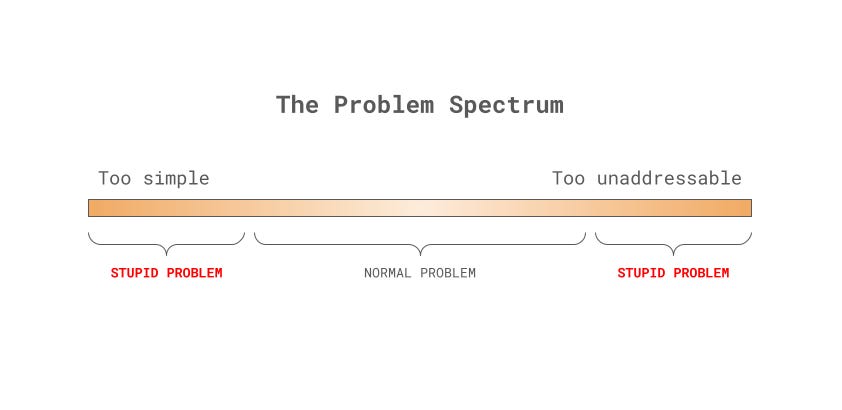
In either case, the system does not allocate serious problem-solving energy to the constraint, and the system ends up dominated by something it is not designed to think about.
Then you have someone like Elon Musk, who is uniquely good at solving stupid problems. With SpaceX, he solved a stupid problem of the seemingly unaddressable kind. You know how we used to launch rockets and just let them crash to Earth and let multi-billion dollar investments become piles of trash because of, you know, gravity? Stupid problem.
For a very long time, the space industry’s self-conception was about launching things into space, not keeping things from crashing. That is, until Elon came along and said, well, what if we just landed them. Or better yet, what if we caught them. Yeah, catch the rockets. Just catch them with some big mechanical chopstick arms.
That’s the thing about stupid problems. They can remain outside a system’s scope for a very long time, while crippling it. But once you solve a stupid problem you can revolutionize an entire industry.
We’re not yet done with the adventures of sheep in solar. My husband recounted a situation where a planned solar farm was contractually prohibited, due to local regulations around wildfires, from mowing between April and June (you know, the time of year when grass grows). As a workaround, the team decided to use sheep.
In coordinating with the local shepherd, they were asked about the makeup of the grass. It turned out that 30% of the grass was toxic to sheep. So the team needed to add a “dead sheep” assumption to the operating model for repaying the shepherd.
Stupid problems live in disregard of your effort. Their absurdity compounds. They muck up your fancy models and scoff at your processes. They’ll grind a system to a halt until that system finally comes to grip with reality.
Maybe we need to figure out a better way to cut grass. Or maybe solar farms shouldn’t be built on grass. Maybe we should build them not on the ground at all. Maybe we should just catch the rockets.